
Introduction:
In my last blog post, “Demystifying Modernisation: True Potential of Cloud Technology” I discussed Application Modernisation and how it is different from Infrastructure and Data Modernisation. As the popularity of containerisation continues to rise to enable the full potential for Application Modernisation, orchestrating and managing containers at scale has become a critical challenge for many organisations. Kubernetes, an open-source container orchestration platform, has emerged as the de facto standard for container management.
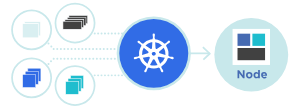
Image Source: https://kubernetes.io/
Google Kubernetes Engine (GKE), a managed Kubernetes service offered by Google Cloud Platform (GCP), takes Kubernetes to the next level by providing a fully-managed environment that simplifies deployment, scaling, and management of containerized applications.
In this blog, we’ll explore the architecture of GKE and highlight its key differentiators from the open-source Kubernetes platform.
Understanding GKE Architecture:
At its core, GKE is built upon the Kubernetes architecture. It leverages the power of Kubernetes to create and manage clusters of virtual machines (VMs) called “nodes” that run containerized applications. However, GKE goes beyond the basic Kubernetes framework by providing additional managed services and integrations that enhance the overall experience of deploying and managing applications.
A GKE cluster consists of two main components:
- The control plane: responsible for managing the cluster, including scheduling pods, managing resources, and providing a way for users to interact with the cluster.
The control plane consists of three main components:
- The Kubernetes API server: This is the main entry point for interacting with the cluster. It exposes the Kubernetes API, allowing users to interact with the cluster.
- The scheduler: This is responsible for scheduling pods onto worker nodes based on resource requirements and availability.
- The controller manager: It manages various controllers responsible for maintaining the desired state of the cluster and is responsible for managing the cluster’s resources, such as pods, services, and deployments.
- etcd: A distributed key-value store that stores the cluster’s configuration and state.
- The worker nodes: the physical machines that run the containers in the cluster and are responsible for executing the application workloads. They are typically virtual machines (VMs) that are provisioned by Google Cloud Platform. GKE manages these nodes by automatically provisioning, scaling, and monitoring them.
GKE Control Plane Management
The GKE control plane can be managed in three different ways:
- Zonal clusters: In a zonal cluster, the control plane is managed by a single zone and worker nodes can also be located in the same zone or different zones within the same region. This is the simplest type of cluster to manage, but it is also the least resilient. This configuration is suitable for scenarios where high availability is not the primary concern, and cost optimisation or locality is a priority.
- Multi-zonal clusters: In a multi-zonal cluster, the control plane is replicated across multiple zones. This provides more resilience than a zonal cluster, but it is also more complex to manage.
- Regional clusters: In a regional cluster, the control plane is replicated across multiple zones in a single region, providing better availability and fault tolerance. In this setup, the control plane components are replicated across zones, allowing the cluster to withstand zone-level failures. Worker nodes can be distributed across multiple zones within the region, providing improved resilience. This provides the highest level of resilience, but it is also the most complex type of cluster to manage.
Comparison to Kubernetes
GKE is a managed Kubernetes service, which means that Google takes care of the underlying infrastructure for you. This includes things like provisioning VMs, managing networking, and applying security patches. This frees up the users to focus on developing and deploying your applications.
- Managed Experience: GKE simplifies cluster management by taking care of the underlying infrastructure, including control plane upgrades, security patches, and scaling. This allows developers and operators to focus on building and running applications without the overhead of managing the Kubernetes control plane.
- Scalability and Performance: GKE leverages Google Cloud’s infrastructure to provide scalability and high-performance computing. It automatically scales the worker nodes based on workload demands and can handle thousands of nodes in a cluster, ensuring efficient resource utilisation and optimal performance.
- Integrated Ecosystem: GKE seamlessly integrates with other Google Cloud services, such as Cloud Storage, Cloud Load Balancing, and Stackdriver Monitoring, providing a unified environment for building, deploying, and monitoring applications. These integrations enhance productivity and enable developers to leverage additional features and capabilities.
Conclusion
Google Kubernetes Engine (GKE) architecture brings the power of managed Kubernetes to developers and operators, providing a seamless and efficient environment for deploying and managing containerized applications. By leveraging the strengths of Kubernetes and integrating with Google Cloud services, GKE offers a compelling solution for organisations looking to embrace container orchestration at scale.
The components of a GKE cluster, including the control plane and worker nodes, work together to ensure the smooth operation of containerized workloads. The GKE control plane manages the cluster’s configuration and state, while the worker nodes execute the application workloads. GKE’s control plane management options, such as zonal, multi-zonal, and regional clusters, provide flexibility and availability based on specific requirements.
Compared to the open-source Kubernetes platform, GKE offers several key advantages. The managed experience eliminates the burden of control plane management, allowing developers and operators to focus on application development. GKE’s scalability and performance benefit from Google Cloud’s infrastructure, enabling efficient resource utilisation and high-performance computing. Additionally, the integrated ecosystem of GKE with other Google Cloud services simplifies application deployment and monitoring.
As containerisation becomes increasingly prevalent in modern software development, GKE stands out as a powerful managed Kubernetes solution. By abstracting the complexities of infrastructure management, GKE empowers organisations to embrace container orchestration with confidence, scalability, and enhanced productivity.
Additional Resources
- Google Kubernetes Engine documentation: https://cloud.google.com/kubernetes-engine/docs/
- Kubernetes documentation: https://kubernetes.io/docs/
- Comparison of GKE, EKS, and AKS: https://www.pluralsight.com/resources/blog/cloud/aks-vs-eks-vs-gke-managed-kubernetes-services-compared



Leave a Reply